Winter weather doesn’t change who’s responsible for a crash. If another driver’s carelessness caused your collision, ice and snow on the road don’t let them off the hook.
Here’s what you need to know about how fault is determined, whether sliding on ice makes you the at-fault driver, and who actually covers your injuries and vehicle after everything goes down.
Is Sliding on Ice an At-Fault Accident?
Not automatically. Sliding on ice is not, by itself, an at-fault accident under Minnesota law. Fault depends on whether a driver used reasonable care for the conditions, not on whether ice was present.
Minnesota Statute 169.14 requires drivers to travel at a speed that’s reasonable and prudent for the conditions and to stay aware of hazards on the road. A driver who loses control because they were going too fast for icy roads can still be found negligent, even if they were going slower than the posted speed limit.
Insurance companies sometimes argue that a crash was simply unavoidable because of the ice. That argument doesn’t override a driver’s duty to adjust for winter conditions.
Minnesota also follows a comparative fault rule. Under Minnesota Statute 604.01, you can still recover compensation as long as your fault isn’t greater than the fault of the driver you’re pursuing, though your damages are reduced by your own percentage of fault. For example, someone found 20 percent at fault would see their compensation reduced by 20 percent.
Because of this, it’s essential to always avoid admitting fault at the scene, even casually. A comment like “I was probably going too fast” can be used against you later. Let the investigation, not a stressed-out remark, determine fault.
Who Is at Fault in a Black Ice Accident?
Fault in a black ice accident usually comes down to whether the other driver adjusted for hazardous conditions they should have anticipated.
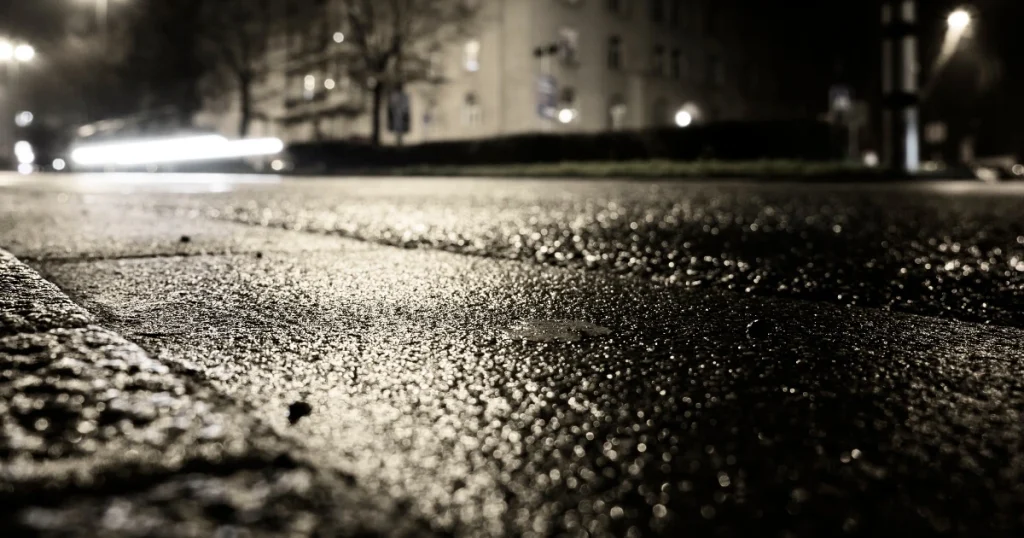
Black ice is a thin, often invisible layer of ice that commonly forms when melted snow or rain refreezes on the road. According to the National Weather Service, black ice is most common in the early morning after overnight refreezing, and bridges and overpasses tend to freeze before other road surfaces because they lose heat from above and below.
Common examples of driver negligence in black ice conditions include:
- Following too closely, which Minnesota Statute 169.18 prohibits regardless of conditions
- Driving too fast for icy or snow-covered roads
- Distracted driving that delays a driver’s reaction to a hazard
Black ice crashes on highways can turn into multi-vehicle pileups. When that happens, fault is often divided among several drivers, using the same comparative fault rules that apply to a two-car accident.
Because black ice is hard to prove after the fact, it helps to document the scene: photos of vehicle positions and damage, dashcam footage, witness statements, the police report, anything.
Does Insurance Cover Snow Accidents and Damage?
Yes, in most cases. Minnesota’s no-fault system means your own auto policy pays a portion of your losses after a snow accident, regardless of who caused the crash. What’s covered, and by whom, depends on what kind of loss you’re talking about.
- Your injuries: Every Minnesota auto policy includes personal injury protection (PIP), with a minimum of $40,000 per person. That includes up to $20,000 for medical expenses and a combined $20,000 for lost income (85 percent of lost wages, up to $500 a week) and related losses, under Minnesota Statute 65B.44.
- Injuries beyond PIP: If your medical expenses exceed $4,000, or your injuries involve permanent injury, permanent disfigurement, death, or a disability lasting 60 days or more, you may also pursue a claim against the at-fault driver’s liability insurance for pain and suffering and other losses PIP doesn’t cover.
- An uninsured or underinsured at-fault driver: Minnesota requires drivers to carry uninsured and underinsured motorist coverage of at least $25,000 per person and $50,000 per accident, according to the Minnesota Department of Commerce. This coverage applies when the at-fault driver has no insurance, or not enough.
- Damage to the other driver’s vehicle: Covered by the at-fault driver’s property damage liability coverage, required at a minimum of $10,000.
- Damage to your own vehicle: PIP doesn’t cover property damage. Repairs typically come from your own collision coverage or from the at-fault driver’s liability coverage.
Report the crash to your insurer as soon as you can. A policy can require notice within a set window, but by law that window can’t be shorter than six months from the date of the crash, under Minnesota Statute 65B.55. If you ever need to file a lawsuit, you’ll have six years from the date of the crash to do so.
Does Comprehensive Insurance Cover Black Ice?
Generally, no, not for a crash. Comprehensive coverage is built for losses other than collisions. According to the Minnesota Department of Commerce, collision coverage applies when your vehicle is involved in an accident with another vehicle or object, while comprehensive coverage generally applies to losses like fire, theft, hail, or hitting a deer. A crash caused by sliding on black ice is a collision, so collision coverage, not comprehensive, is what typically applies if you carry it.
Coverage always comes down to your specific policy language, so it’s worth a quick call to your agent or insurer to confirm exactly what your policy includes.
Who Can Be Liable in a Minneapolis Black Ice Crash?
Many drivers mistakenly believe that black ice automatically absolves everyone of responsibility in a crash. However, this is simply not true. Minnesota law requires all drivers to adjust their driving behavior for winter weather conditions, including the possibility of black ice formation. When drivers fail to take appropriate precautions, they can be held liable for resulting crashes and injuries.
What Should I Do Immediately After a Snow or Ice Crash?
- Check for injuries and call 911 if anyone is hurt
- Move to safety if you can, and turn on your hazard lights
- Document the scene: vehicle positions, damage, road conditions, and any skid marks
- Exchange insurance and contact information with the other driver
- Report the crash to the police and to your insurer
- Talk to an attorney before giving a recorded statement to any insurance company
For a deeper walkthrough of the minutes right after an accident, see our guide on key steps to take after a winter car crash.
Get the Support You Need
Snow and ice don’t erase a driver’s responsibility to drive safely, and they shouldn’t erase your right to compensation either. If you were hurt in a Minnesota snow or ice crash, TSR Injury Law can help you sort out who’s at fault and who pays.
TSR Injury Law has recovered over $1 billion for injured Minnesotans. Our attorneys work on contingency, so you pay nothing unless we win your case. Call (612) TSR-TIME today for a free, no-obligation case review.